

Jochebed's Faith: When Pharaoh Pursues, Your Child's Life Hangs in the Balance—How Do You Secure Their Future?
Pharaoh's Decree of Death: Seeing God's Glimmer of Hope in the Darkest Era
Modern people often lament being born at the wrong time or feel crushed by the heavy burdens of life, but these pale in comparison to the terror Jochebed faced. Let us first imagine the historical background: it was an era of extreme oppression and despair. Pharaoh had issued a brutal decree of genocide—every Hebrew baby boy was to be thrown into the Nile River and drowned.
In these days where "even breathing felt terrifying," an ordinary Levitical family welcomed a new life. This should have been a joyous occasion, but at this moment, it became the heaviest of trials. Yet, we see that right by this despairing Nile River, through Jochebed's faith, God ignited a glimmer of saving hope.
Spiritual Depths: Six Spiritual Traits of Jochebed That Changed History
Why could Jochebed transform from a terrified mother into a hero who changed history? We must look not only at what she did but, more importantly, at the inner state of her life. She exuded six beautiful spiritual traits:
1. Fearing God More Than Fearing Man: Defying Pharaoh was a capital offense at the time. But Jochebed had a standard in her heart; she knew who the true Lord of life was. Her reverence for God gave her the confidence to stand against evil powers. Brothers and sisters, when the world's values conflict with God's Word, whom do you fear?
2. Courage is Not the Absence of Fear, But Acting with Faith: The Bible records that she saw the child was "fine" and hid him for three months. During these ninety-plus days, every cry of the infant might have terrified her, yet she was not paralyzed by fear.
3. Seeing God's "Good" (Tov) and Having Spiritual Vision: The Bible says she saw the child was "fine." The original Hebrew word used here is "טוֹב (Tov)," which is the exact same word God used during the creation of the heavens and the earth in Genesis when He said it was "good." This was not merely a mother seeing her baby as cute; rather, she "saw God's heart and purpose." By the death-filled Nile, she used her spiritual vision to see God's calling and hope.
4. The Combination of Wisdom and Strategy: When the child could no longer be hidden, she did not blindly test her luck. Faith is not "recklessness." She got a papyrus basket and meticulously coated it with tar and pitch. In Hebrew, the word for "basket" is "תֵּבָה (Tebah)," a word that appears only twice in the entire Old Testament: once for Noah's "Ark," and the other time right here. Jochebed was building a miniature ark of salvation for her child. She placed the basket among the reeds to avoid the strong currents, and also to wait for the "right timing."
5. The Highest Level of Surrender: The moment she opened her hands and left the basket by the riverbank, she completed a most profound sacrifice. She knew that her power to protect was limited, but God's power is infinite. "Letting go" is not giving up; it is transferring sovereignty over to God.
6. Shaping the Life of a Leader: Later, God opened a way (see the next section), allowing her to legally raise her child in the capacity of a "wet nurse." During those years, she didn't just nurse him; she seized the opportunity to instill faith, ethnic identity, and a thirst for God into Moses, drop by drop. She profoundly influenced the leader of an era.
Impact: Your One Step, God's Giant Leap
Jochebed might have thought at the time, "I just want to save my child." But through her tiny faith, God brought about a kingdom-shaking impact, demonstrating breathtaking redemptive-historical theology and God's unfathomable Providence:
Deliverance in Despair: Who could have imagined that while Pharaoh intended to use the Nile to destroy Israel's future, God would have Pharaoh's daughter save Moses, and even have Pharaoh pay Moses' own mother to raise him? When you are willing to take the first step of faith, God will take over the remaining ninety-nine steps.
A Kingdom Turning Point: Moses later became the mediator who led the Israelites out of Egypt, delivered the law, and stood in the gap to intercede. The starting point of all this greatness originated from a mother's "refusal to give up" faith by the river.
Life Application: The "Papyrus Basket" in Our Lives
Finally, I would like to invite everyone to ponder three questions that are closely related to our lives:
When you can "no longer hide it," do you dare to surrender? Jochebed hid her child for three months until she "could hide him no longer." In our lives, there may also be burdens, dreams, or difficulties (such as finances, marriage, or health) that we desperately try to protect but are on the verge of losing grip on. Reflection: Do you currently have a difficulty in your hands that you can "no longer hide"? Are you willing, after doing your part (coating it with pitch), to place it into the "ark" of prayer (handing it over to God's sovereign control)?
The Highest State of Parenting: Holding on Tight or Letting Go? Regarding our children or the flock we lead in our small groups, do we hold onto them tightly, or do we seize the time to teach them to know God, so that when they enter society (enter Pharaoh's palace), they can still recognize their own God?
Who is your "Miriam" or "Pharaoh's Daughter"? This tells us that God's work requires a team. When those around us are suffering, are we willing to go the extra mile to observe, to show compassion, and to become a turning point in someone else's life?
Conclusion: Your Faith Can Sustain the Hope of the Future
The name Jochebed means "Yahweh is glory."
Brothers and sisters, do not underestimate any seemingly insignificant act of faith on your part. Perhaps you are currently standing by your "Nile River," feeling desperate and pressured. But please remember, as long as you are willing, like Jochebed, to fear God, live with spiritual vision, and offer your difficulties as a living sacrifice, God can use you, just as He used Jochebed, to pass on faith and impact future generations.
May we all become the ones who still build arks for God in the darkest of eras.
Frequently Asked Questions (FAQ) about Exodus 2:1-10
Q1: Why did Jochebed only hide Moses for three months? As a three-month-old infant, his mobility increased and his cries grew louder. Continuing to hide him would have risked the execution of the entire family (including Aaron and Miriam). This was the helplessness of reaching human limits, but also the turning point that forced her faithful surrender.
Q2: Does the original biblical text explicitly equate the papyrus basket with the Ark? Yes. The Hebrew word "תֵּבָה (Tebah)" is used only twice in the Old Testament: Noah's massive Ark and Moses' miniature papyrus basket. Both symbolize the salvation and refuge personally provided by God amidst the flood of death and judgment.
Q3: Why would Pharaoh's daughter risk adopting an enemy Hebrew baby boy? The scripture specifically notes that the baby cried, and Pharaoh's daughter "felt sorry for him." This highlights God's sovereign control over human hearts. He can even awaken compassion in the enemy's camp to accomplish His divine redemptive plan, demonstrating God's wondrous providence.
✝Scripture References
“And there went a man of the house of Levi, and took {to wife} a daughter of Levi.”
Exodus 2:1→ View full chapter“And the woman conceived, and bare a son: and when she saw him that he {was a} goodly {child}, she hid him three months.”
Exodus 2:2→ View full chapter“And when she could not longer hide him, she took for him an ark of bulrushes, and daubed it with slime and with pitch, and put the child therein; and she laid {it} in the flags by the river's brink.”
Exodus 2:3→ View full chapter“And his sister stood afar off, to wit what would be done to him.”
Exodus 2:4→ View full chapter“And the daughter of Pharaoh came down to wash {herself} at the river; and her maidens walked along by the river's side; and when she saw the ark among the flags, she sent her maid to fetch it.”
Exodus 2:5→ View full chapter“And when she had opened {it}, she saw the child: and, behold, the babe wept. And she had compassion on him, and said, This {is one} of the Hebrews' children.”
Exodus 2:6→ View full chapter“Then said his sister to Pharaoh's daughter, Shall I go and call to thee a nurse of the Hebrew women, that she may nurse the child for thee?”
Exodus 2:7→ View full chapter“And Pharaoh's daughter said to her, Go. And the maid went and called the child's mother.”
Exodus 2:8→ View full chapter“And Pharaoh's daughter said unto her, Take this child away, and nurse it for me, and I will give {thee} thy wages. And the woman took the child, and nursed it.”
Exodus 2:9→ View full chapter“And the child grew, and she brought him unto Pharaoh's daughter, and he became her son. And she called his name Moses: and she said, Because I drew him out of the water. {Moses: that is, Drawn out}”
Exodus 2:10→ View full chapter🙏Today's Prayer
Lord, I thank You that You are the God who reigns even in darkness and despair. When I face difficulties in life that I can "no longer hide or hold onto," grant me the faith and wisdom of Jochebed. Help me to do my part, and bravely place everything I cherish and fear into the ark of Your grace. I believe that Your providence is greater than all the powers of this world. In Jesus Christ's name I pray, Amen.
Related Posts
Hannah: How Can the Pain of Barrenness Become a Turning Point for God's Kingdom?
When prayers go unanswered, dreams shatter, and days feel hopeless, what do you do? Hannah's story shows us that even at...
Rahab of Jericho: Can a Prostitute Rewrite Her Destiny and Bless Her Family?
Feeling defined by past mistakes or societal judgment? Rahab, a marginalized outsider in Jericho, found God at the brink...
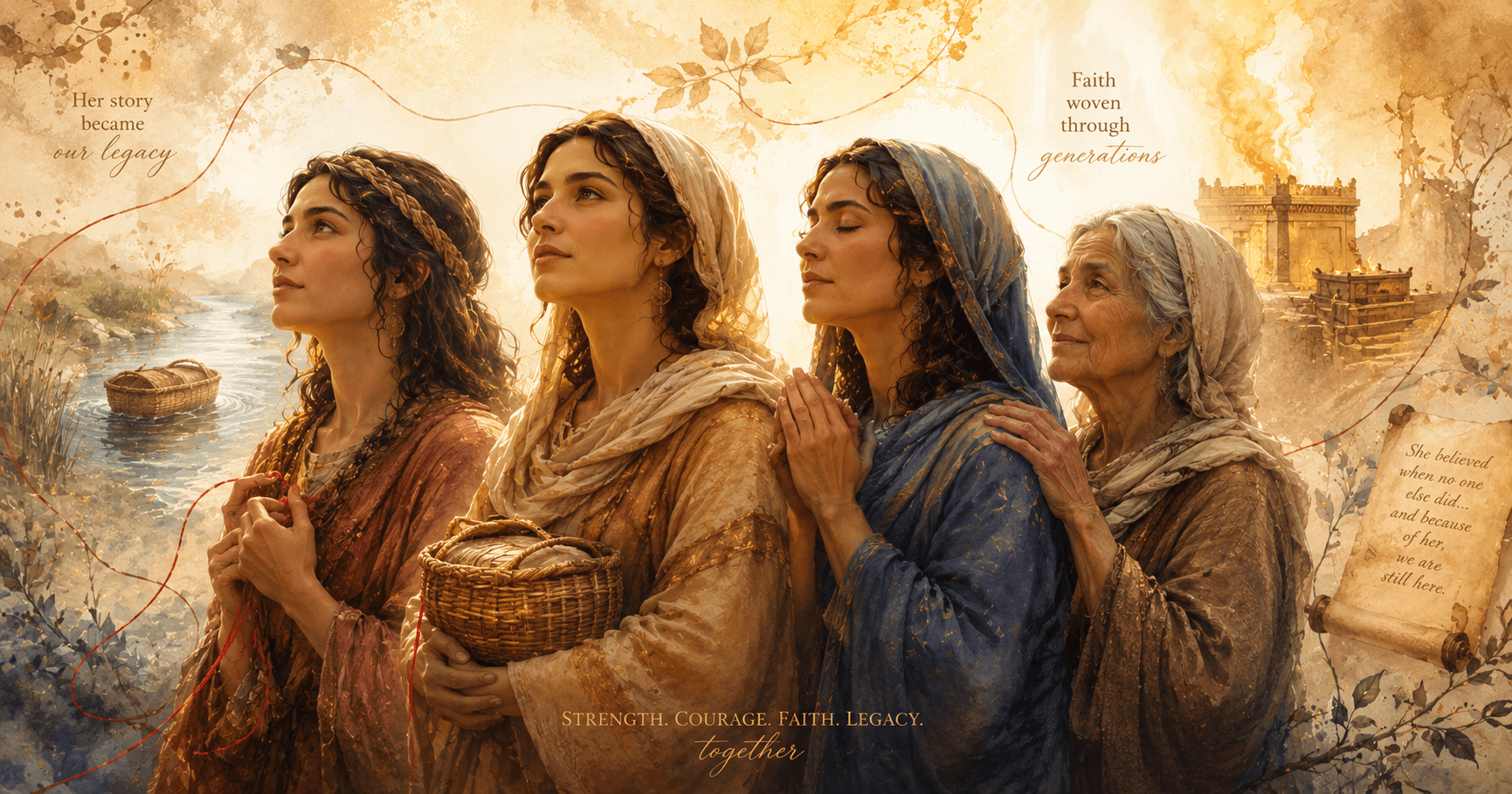
Rahab, Jochebed, Hannah, Lois: How Did Four Women Overcome Impossible Odds?
When you feel small or unseen, the stories of Rahab, Jochebed, Hannah, and Lois from the Bible show how God uses ordinar...