
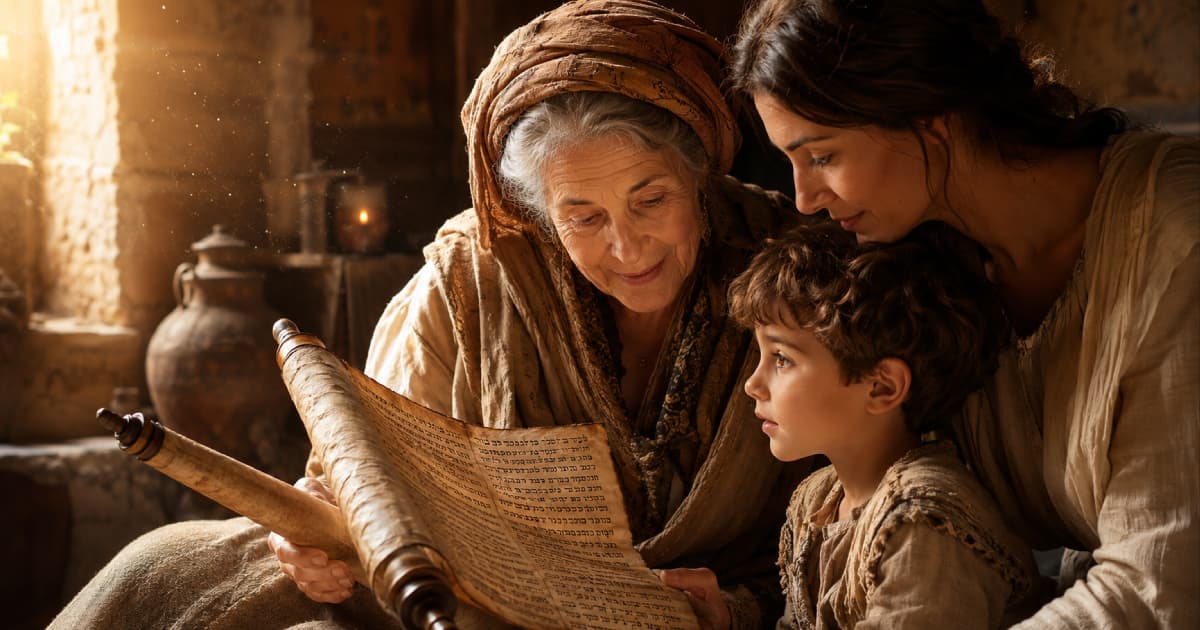
Lois and Timothy: Passing on Faith in Diverse Families, How to Face the Challenges?
In the Tears of the Prison, Paul Saw an Eternal Family Spiritual Asset
Living in a modern society characterized by rapidly shifting values and highly fragmented information, parents and elders often share a deep, collective anxiety: When the values of this generation are collapsing, what exactly should we equip the next generation with so they can stand firm in an uncertain future? The Apostle Paul’s final testament before his martyrdom—the Book of 2 Timothy—provides a soul-stirring answer.
The year was approximately AD 67. Paul was confined in the cold, dark depths of the Mamertine Prison in Rome, facing imminent execution (2 Tim 4:6). His sharpest concern was for Timothy, his young disciple who was naturally timid, weeping under pressure, and battling heresies and persecution in Ephesus. In this life-or-death moment, Paul did not offer advanced church management strategies. Instead, through his "night and day prayers and memories" (vv. 3-4), Paul directed Timothy’s gaze backward to the most defining, invisible asset of his life: a genuine spiritual legacy spanning three generations, flowing directly from his grandmother Lois.
The Extraordinary Power in an Ordinary Family: An Unmasked "Sincere Faith"
What truly pierces through generations and transforms a child's heart is not outward religious conformity or moralism, but an unmasked, living reliance on God demonstrated by elders in daily life.
Lois appeared to be an entirely ordinary grandmother, yet in verse 5, Paul uses two crucial Greek terms to accurately depict her highly influential spiritual character. The first is "sincere faith" (Greek: anypokritos pistis, ἀνυπόκριτος πίστις). Anypokritos is a compound word: the prefix a- denotes negation, while the root stems from the word for a theatrical actor who wears a mask (hypocrite). Literally, it means "unhypocritical, without a mask, non-performative." Lois’s faith contained no falsehood; it was not a religious costume worn only in the synagogue. Rather, it was an authentic, inward relationship of trust lived out in the kitchen, the living room, and during life's crises.
The second term indicates that this faith "first lived (enōkēsen, ἐνῴκησεν) in your grandmother Lois." Enōkēsen means "to make a home, to indwell permanently." Faith was not an occasional visitor in Lois’s life; it was the master of her household. Historically, Timothy lived in Lystra. His father was an unbelieving Greek, while his mother and grandmother were Jews. In this culturally mixed, spiritually mismatched home, Lois did not seek an easy spiritual environment. Every day, she intentionally focused her heart on her daughter and grandson, quietly and faithfully upholding God's Word within the family. This extraordinary trait hidden in an ordinary life became the immovable bedrock of the entire household.
From Eunice to Timothy: The Chain Reaction of Holding Fast to God's Word and Its Redemptive Significance
The grand narrative of God's redemptive plan is rarely propelled by the monumental gears of history, but is often achieved through the faithful transmission of God's Word by two generations of women in an ordinary family.
In verse 3, Paul mentions serving God "as my ancestors did," indicating that what Lois and Eunice preserved was the devout Old Testament faith that eagerly anticipated the Messianic promise. When Paul preached the Gospel, Lois’s faith—rooted deeply in the Old Testament—immediately recognized Christ. Her faith beautifully bridged the Old Testament promise and the New Testament Cross.
Lois’s godly life triggered a highly tangible chain reaction of spiritual legacy:
Influence on her daughter Eunice: Eunice fully inherited her mother's traits, establishing a foundation of sincere faith and a godly lifestyle. This birthed in her a profound sense of spiritual responsibility for the next generation (Timothy).
Influence on Timothy: Due to the intentionality of his grandmother and mother, Timothy knew the Holy Scriptures from childhood (2 Tim 3:15), laying a solid foundation of truth. He perfectly replicated the sincere faith of the two generations before him. It was this foundation, built quietly in the daily routines of family life, that equipped Timothy to be chosen by Paul as a vital co-worker. The power to change generations is hidden in family discipleship.
Rebuilding the Modern Family Altar: Practice "Transparent Vulnerability" and "Living Room Narratives" This Week
Based on the spiritual example of grandmother Lois, if we want to pass down our faith in this collapsing generation, we can implement two practical life shifts this week:
Drop the Religious Mask and Practice "Transparent Vulnerability": The breach in spiritual legacy often occurs when the younger generation sees a double standard—one for the church and one for the home. This week, try dropping your mask of perfection before your children. When you face a setback or lose your temper, do not cover it up. Take the initiative to apologize and invite your family to pray for your weakness. Let them see a "real sinner in need of grace" rather than an "expert hypocrite."
Reshape Living Room Conversations with "God's Faithful Deeds": Reduce the time spent discussing secular anxieties (such as academic rankings or financial achievements) at home. Like Lois, focus your heart intentionally on your descendants. Schedule a specific time each week, perhaps after dinner, where elders or parents take the lead in sharing a real experience of how God worked in their lives that week. Make "the Word of God" the daily narrative of your living room.
Frequently Asked Questions regarding 2 Timothy 1:3-5 (FAQ)
Q1: Timothy’s father was an unbelieving Greek. What comfort does this offer to modern elders in spiritually divided homes?
This brings immense hope to modern families. The key to spiritual legacy is not a flawless family structure, but whether someone is willing to live out a "sincere faith" in ordinary life. Even with an unbelieving spouse, Lois and Eunice built a solid foundation for Timothy through their daily devotion. God's power is not limited by household structures.
Q2: What unique challenges does "sincere faith" (Anypokritos) face in today's social media age?
Modern society is driven by a highly "performative" culture, where everyone is accustomed to wearing perfect "masks" on social media. Believers today easily turn faith into a religious performance reserved for Sunday worship. If we revert to secular values at home, this double standard directly destroys the next generation's trust in the faith.
Q3: Paul emphasizes that faith passed from Lois to Eunice to Timothy. What does this imply for church ministry?
This demonstrates that spiritual legacy requires a healthy "spiritual ecosystem." The older generation (grandmother) sets the example, impacting the parents (mother), who ultimately nurture the next generation (Timothy). Churches shouldn't allocate resources solely to youth ministries; they must deeply value and equip the older generation, empowering elders to be a strong spiritual covering for young families.
🙏Today's Prayer
Gracious Heavenly Father, thank You for the life of an ordinary grandmother, Lois. Through her, we see that the daily routines of family life hold a spiritual power capable of resisting the collapse of generational values. Strip away all our religious masks and grant us an inward, permanently indwelling "sincere faith." Help us to live out a true example of dependence on Your grace before our children and spiritual youth. May Your holy Word take deep root in the hearts of the next generation through our faithful endurance. In the precious and holy name of Jesus Christ, we pray, Amen.
Related Posts

Acts 20:24: Paul's Eight "No Matters" in Preaching the Gospel—How Many Have You Truly Experienced?
Paul lived out eight 'no matters' in Acts 20:24—no matter the circumstances, audience, cost, or whether facing life or d...
Hannah: How Can the Pain of Barrenness Become a Turning Point for God's Kingdom?
When prayers go unanswered, dreams shatter, and days feel hopeless, what do you do? Hannah's story shows us that even at...

Jochebed's Faith: When Pharaoh Pursues, Your Child's Life Hangs in the Balance—How Do You Secure Their Future?
When a cruel decree threatens your child's life, what can you do? Jochebed shows how not to give up hope under extreme o...